
Nowadays, authoritative academic journals Science and Nature publish over a dozen studies on 3D printing technology every year, but not many have truly achieved commercial applications. The most successful commercialized 3D printing Science level research is the article "Continuous liquid interface production of 3D objects" published on March 20, 2015.
This article discusses the continuous liquid surface forming technology. UV curable liquid resin 3D printing is described as having gone through three generations of product development: the first generation is stereolithography technology (SLA), which uses laser point by point scanning of a single material liquid resin; The second generation is known as digital light projection technology (DLP, LCD, etc.), which uses projection to achieve layer exposure and shaping of patterns; The third generation is continuous liquid surface manufacturing technology (CLIP, etc.), which achieves continuous and uninterrupted manufacturing of up to 3000 millimeters per hour through different window configurations, which is 25-100 times higher than traditional UV curing technology. In addition, there is resin spraying technology, which also belongs to a type of photocuring technology.
CLIP technology is a development of traditional DLP technology. The printing process of regular DLP involves a cycle of four steps: exposure, platform lifting, resin filling, and platform lowering for re exposure; The printing process of CLIP is much simpler, it only has continuous exposure and pull-up process. The difference between the two is clear at a glance. During the DLP printing process, the platform rise and fall are complex. The reason is that during DLP molding, each layer must be lifted enough to flow into the resin, and then lowered by a certain distance to ensure the layer thickness. Moreover, the newly exposed layer is easily bonded to the bottom of the resin tank (resulting in limited lifespan of the resin tank).
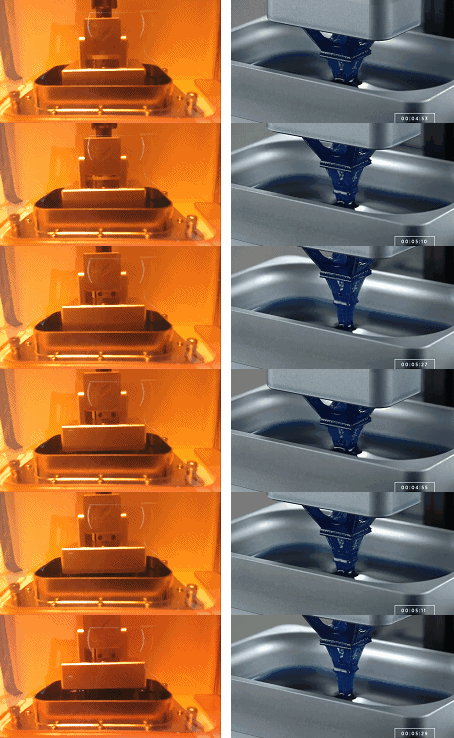
Comparison of Printing Processes between Traditional DLP and CLIP Technologies
CLIP technology relies on the oxygen blocking effect of the so-called Dead Zone, which can avoid adhesion between the forming layer and the resin tank, allowing for continuous and uninterrupted printing, while also having extremely high manufacturing accuracy. The paper at that time pointed out that this technology is suitable for printing soft elastic materials, ceramics, and biomaterials, and believed that it has the potential to extend the practicality of additive manufacturing to many scientific and technological fields, and reduce the manufacturing cost of complex polymers.
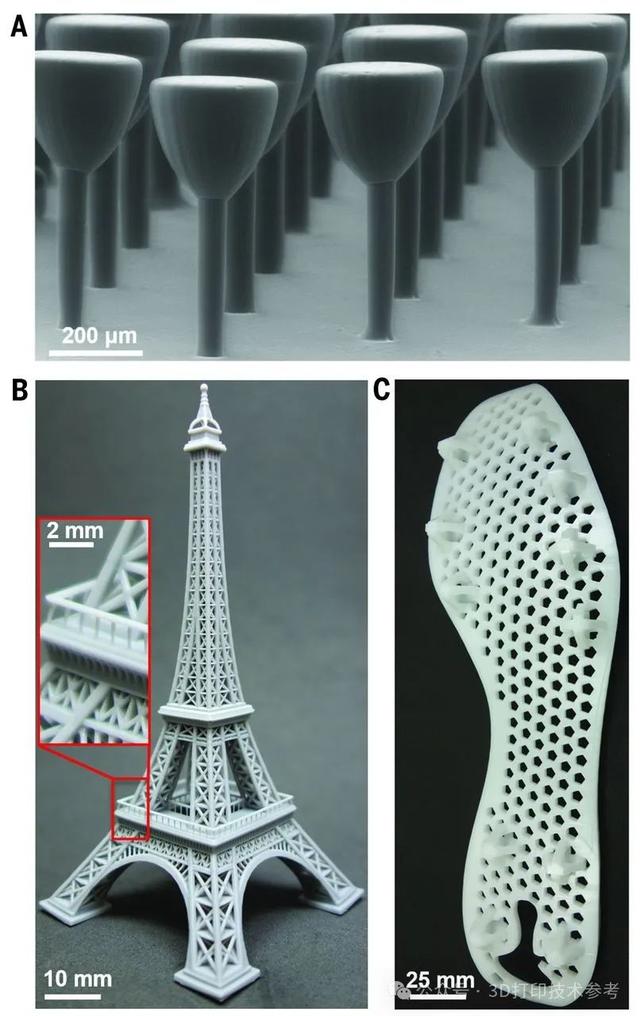
The paper points out that CLIP technology has extremely high detail manufacturing capabilities
In fact, the development company Carbon3D for CLIP technology has indeed achieved tremendous commercial success. It has connected almost all key links that affect the implementation and application of 3D printing technology: software design, material performance, and production level printing speed. Therefore, it is not only a 3D printing equipment manufacturer, but also a material supplier and software company. It has developed deeply influential lattice design and optimization software, as well as a series of programmable resins, paving the way for commercial applications and obtaining multiple rounds of financing worth billions of dollars.
In terms of business model, Carbon adopts a model of only renting and not selling, charging fees on an annual basis. On the one hand, this reduces the initial investment pressure for end-users to try Carbon technology, and on the other hand, it also makes it easier for end-users to switch to updated versions of devices when facing later updates in Carbon equipment technology.
The most successful support for its commercialization undoubtedly comes from the cooperation with Adidas, and both sides can be said to have achieved mutual success. Nowadays, Carbon3D relies on Clip technology to cover 3D printing applications in various fields such as consumer goods, automobiles, dentistry, sports, industry, etc. It has customers in 17 countries/regions, partners are mostly international brands, and continues to expand globally.
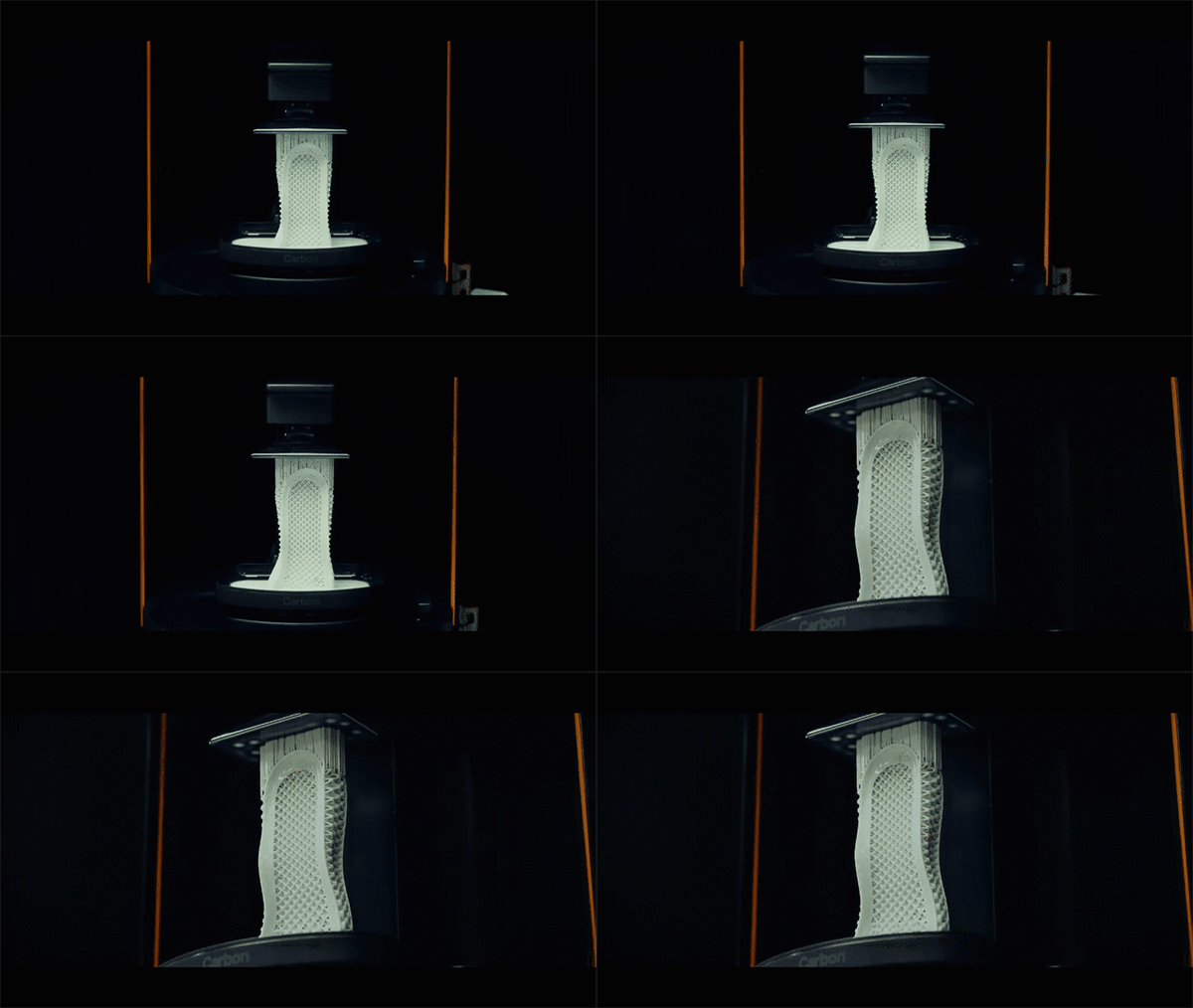
The Forming Process of Adidas 3D Printing Sports Sole
Of particular note, after achieving commercialization success, the company did not engage in a series of acquisitions like other unicorns back then, but focused on the commercial development of this technology. And Desktop Metal is a typical example of the opposite.
The above information is sourced from the internet and must be deleted for infringement